Updated (04/03/2025): Following the publication of the news: The National Court upholds the fine imposed on Vueling for having a website that is inaccessible to people with disabilities.
Complying with digital accessibility regulations has become a priority over the last year for many businesses. However, many organisations still underestimate its importance, which can lead to serious legal consequences, financial penalties, and reputational damage.
What is digital accessibility?
Digital accessibility lies in ensuring that websites, applications, and digital platforms are usable by everyone, including those with disabilities. This implies following international standards such as the Web Content Accessibility Guidelines (WCAG) and complying with regulatory frameworks (EAA, ADA, RGAA…), such as Equal Opportunities Acts or specific laws regarding technology and disability.
Why is it important to invest in accessibility?
Beyond being a regulatory obligation and a compliance requirement, investing in digital accessibility is a strategic and ethical decision that benefits your company on multiple levels, in addition to complying with current regulations. Below are the most important reasons for doing so:
- Market and audience expansion: An accessible site reaches a wider audience, as 15% of the global population lives with some form of disability, representing a market with significant purchasing power.
- Improved User Experience (UX): Accessible design facilitates navigation for everyone, with better contrast, clear descriptions, and an intuitive structure.
- Compliance with accessibility regulations: Ensures your company complies with laws such as WCAG, the ADA, or local regulations, avoiding fines and lawsuits.
- SEO benefits: Search engines like Google favour accessible sites with well-defined tags and hierarchies, improving ranking.
- Competitive advantage: Prioritising accessibility improves brand perception and positions the company as a leader in inclusion and social responsibility.
- Risk and cost reduction: Implementing accessibility from the start avoids penalties and is more economical than correcting issues following audits or lawsuits.
- CSR Compliance: Demonstrating a commitment to accessibility reinforces values of inclusion and diversity, which are increasingly valued by consumers and investors.
What penalties can your company receive for not complying with digital accessibility regulations?
Non-compliance with digital accessibility regulations can lead to serious legal consequences and financial penalties. Different regulatory frameworks in Europe and Spain establish sanctions for companies that do not guarantee an accessible digital environment.
At a European level, Directive 2016/2102 establishes accessibility requirements for public sector websites and mobile applications of Member States. Although initially focused on public bodies, it has significantly influenced private sector regulation. Penalties vary according to the internal legislation of each country, but the trend is to impose fines proportional to the level of non-compliance and the impact generated. For example, in Spain, fines can range between €5,000 and €300,000, depending on the severity of the infringement.
Furthermore, the European Accessibility Act (EAA), which came fully into force in June 2025, extends the scope to digital products and services of private companies, such as e-commerce platforms, banking applications, and telecommunications services. Failure to comply may lead to significant financial penalties and the inability to market products and services within the European market.
Real cases of fines for non-compliance
There are several recent examples of companies sanctioned for failing to comply with digital accessibility regulations:
- Vueling Airlines (Spain, 2024): The organisation was fined 90,000 euros for failing to guarantee access for persons with disabilities on its website. Additionally, it was banned from accessing public aid for six months.
- Endesa (Spain, 2018): A fine of 30,001 euros for failing to meet accessibility requirements on its customer service portal.
- Domino’s Pizza (USA, 2019): The company was sued and forced to modify its website and mobile app after failing to comply with the Americans with Disabilities Act (ADA).
- Iberia (Spain, 2015): In July 2015, the Secretariat of State for Social Services and Equality proposed sanctioning Iberia with a fine of 30,001 euros for the lack of accessibility of its website for persons with disabilities. This sanction proposal was announced by the Spanish Committee of Representatives of Persons with Disabilities (CERMI).
What other risks does your company face besides fines?
The impact of non-compliance with digital accessibility regulations goes beyond financial penalties. It can also seriously damage your company’s reputation and competitiveness:
- Reputational damage: A lack of accessibility can be perceived as discrimination, damaging your brand’s public image. Criticism on social media and bad press can lead to a loss of customers and business partnerships.
- Exclusion from tenders and contracts: Many public administrations and large companies require compliance with accessibility regulations to award contracts. Failure to comply can mean exclusion from key opportunities.
- Loss of customers: An inaccessible website excludes millions of people with disabilities, reducing conversions and customer satisfaction.
- Additional costs for late correction: Correcting accessibility issues after a lawsuit or audit is much more costly and complex than implementing them from the start of the project.
How to avoid penalties and guarantee digital accessibility?
To avoid penalties and ensure an inclusive digital environment, your company can take the following measures:
- Conduct a deep accessibility audit of your digital assets: Partner with providers that have proven experience, accreditation, and certified professionals.
- Apply WCAG standards: Implement the Web Content Accessibility Guidelines (WCAG), a global standard that defines technical criteria for an accessible site.
- Train the team: Offer continuous training to designers and developers on digital accessibility.
- Consult with experts: Collaborate with consultants specialising in digital accessibility to guide the adaptation process.
- Maintain continuous improvement: Accessibility is not a one-off process, but a continuous one. Conducting periodic reviews is key.
Protect your company and boost your growth with digital accessibility
Ignoring digital accessibility standards can expose you to financial penalties and legal action, affect the public perception of your company, as well as significantly reduce the chances of expanding your market presence.
Tech4access’s Service for Integrated digital Accessibility (SIA®) offers a complete solution to ensure regulatory compliance through specialised audits, continuous improvement plans, and certifications compliant with WCAG and EN 301 549 standards. With our support, your company will not only comply with current legislation but will also strengthen its reputation and open up new opportunities in a market increasingly conscious of accessibility.
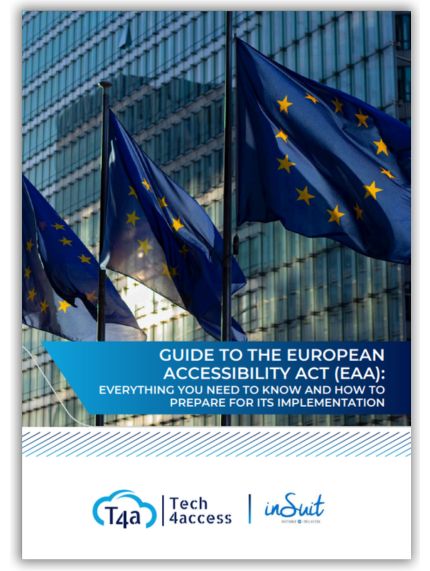
Furthermore, with the European Accessibility Act coming into force on 28 June 2025, we have prepared a practical guide to help you understand and implement this new European regulation. Download it and discover how to ease legal compliance while positioning your company as a benchmark in digital accessibility.